How to Write a Two-Page Resume: When One Page Is Not Enough
The debate over whether a resume should be one page or two has outlasted most hiring trends, and it remains one of the most frequently misunderstood rules in professional job searching. For entry-level candidates with little experience, a single page is almost always right. But for mid-career professionals, senior leaders, academics, and technical specialists with a legitimate body of work, forcing everything onto one page does not demonstrate conciseness — it demonstrates that you edited away the evidence a hiring manager actually needed. This guide covers exactly when a two-page resume is appropriate, how to structure both pages so the hiring manager reads all the way through, what to cut even on a two-page document, how to handle page breaks without creating awkward reading gaps, and how the principles of a well-organised two-page resume translate directly into a stronger, more credible application.
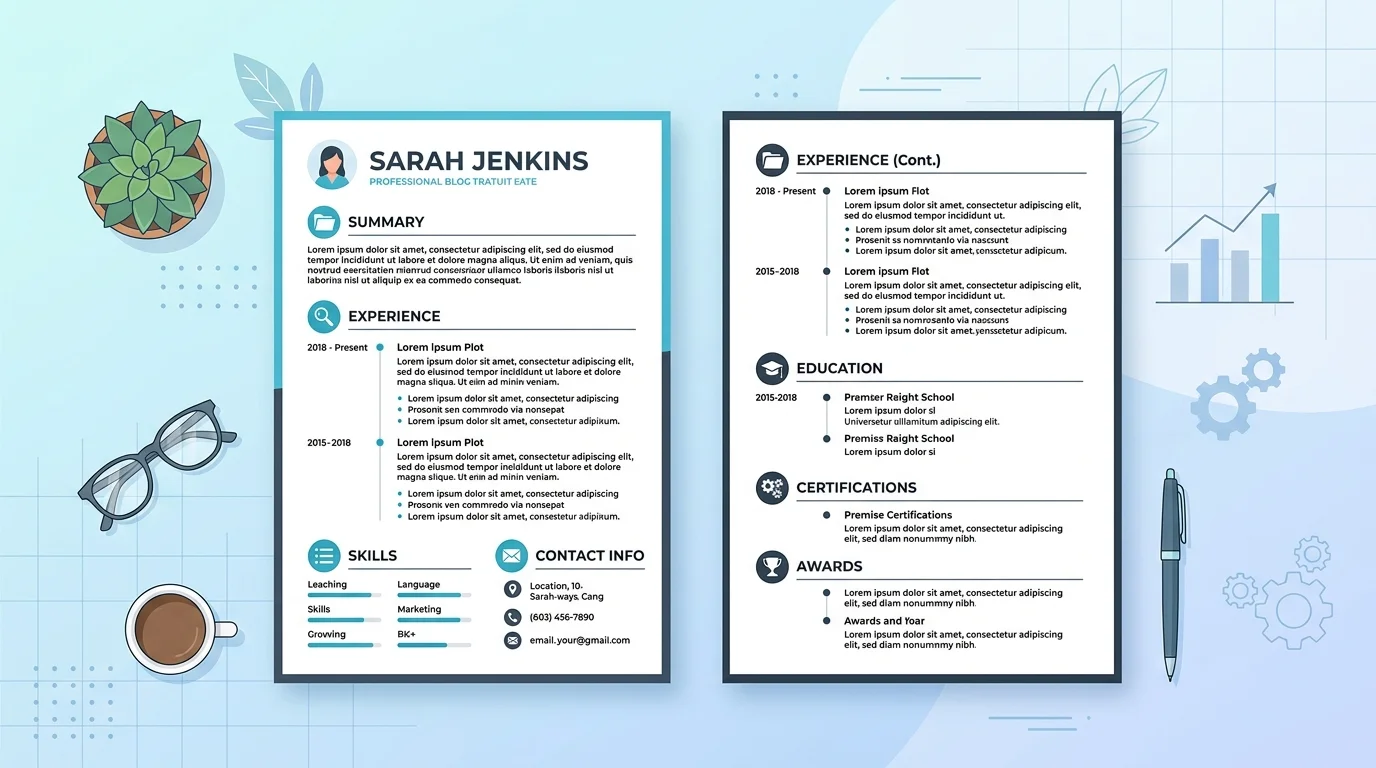
The one-page rule: where it came from and why it is misapplied
The one-page resume rule originated in an era when resumes were physically mailed, printed, and sorted by hand. A single sheet was practical — it was easier to file, easier to photocopy, and less likely to be separated across a pile of applicants. That era ended roughly three decades ago. Modern hiring processes are almost entirely digital, and a hiring manager reviewing applications through an ATS or a PDF viewer faces no physical inconvenience from a second page.
The rule persisted long after its practical basis disappeared, partly because career advisors kept repeating it, and partly because it contains a kernel of genuine truth: a resume stuffed with filler, padding, and irrelevant information to reach a second page is worse than a tight one-page document. But somewhere in that transmission, the underlying principle — every line should earn its place — got replaced by a blunt directive — one page, always, for everyone.
That directive does genuine damage to experienced candidates. A professional with twelve years of progressively responsible work in three companies, a postgraduate degree, two significant certifications, and a list of technical skills directly relevant to the role cannot honestly represent themselves in three hundred and fifty words. Trying to do so forces them to compress their experience into bullet points so brief they lose all meaning, or to drop entire roles that would have told the story of their career arc. The result is a resume that looks lean but reads thin.
Understanding where the rule came from — and when it does not apply — is the starting point for making a confident, well-reasoned decision about length rather than one driven by anxiety about breaking a convention that may not serve your particular candidacy.
When a two-page resume is genuinely the right choice
A two-page resume is appropriate in four distinct situations, and each situation has a clear underlying reason that a hiring manager would agree with if you explained it to them.
The first situation is mid-to-senior career professionals with seven or more years of directly relevant experience. At this stage, your career history contains enough substantive content — roles, responsibilities, measurable achievements, and career development — that compressing it onto a single page requires cutting information that a senior hiring manager would expect to see. For a Director of Operations, a Senior Software Engineer, or a Head of Marketing, a two-page resume is not indulgent. It reflects the actual scope of a career that has had time to develop meaningfully.
The second situation is professionals applying for roles in industries where documentation density is an occupational norm — academia, law, medicine, scientific research, and engineering. In these fields, the curriculum vitae format is standard and can run to many pages. A two-page resume in these contexts is restrained by comparison and entirely appropriate for the hiring culture.
The third situation is candidates with significant technical skill sets that cannot be abbreviated without losing meaning. A cloud infrastructure engineer applying for a senior role needs to communicate fluency across a specific stack of technologies and platforms. A data scientist needs to indicate their command of languages, libraries, and statistical frameworks. These lists cannot always be meaningfully shortened without removing the signal that the hiring team is looking for.
The fourth situation is professionals whose career includes multiple distinct periods of achievement that each contribute to the story of their candidacy. A career changer who spent eight years in finance before moving into product management has a two-act career narrative. Both acts are relevant to a senior product role; neither can be cut without creating a gap in the story the hiring manager needs to follow.
When you should stay on one page
The two-page resume is a legitimate choice in the situations described above. It is not, however, a universal upgrade. There are specific circumstances where expanding to two pages weakens rather than strengthens your application.
Entry-level candidates and recent graduates should almost always stay on one page, not because of convention but because they do not yet have enough substantive professional content to fill a second page credibly. Padding a one-page resume with extended course descriptions, club memberships, or high-school achievements to justify a second page does not make the resume more impressive — it makes it visibly thin in a larger container.
Professionals with five years or fewer of experience in a single career track should approach a second page with real caution. Five years of experience can fit on one tight, well-organised page when written correctly, and a one-page resume at that career stage often reads as crisper and more confident than a two-page document that is clearly filling space.
Any candidate who is considering a second page primarily because they cannot decide what to cut should treat that indecision as a signal to edit harder rather than expand. The question to ask of every element on the resume is not "is this true?" but "does a hiring manager for this specific role need to know this to make a decision about interviewing me?" Content that does not clear that bar belongs off the resume regardless of which page it would have appeared on.
How to structure a two-page resume for maximum impact
The structural logic of a two-page resume is different from a one-page resume, and understanding that difference is what separates a two-page document that a hiring manager reads entirely from one that gets skimmed for the first half and abandoned.
Page one carries everything that must be seen immediately: your contact information, your professional summary or objective, your most recent and most relevant role or two, and — if it is a high-signal section for your target role — the top of your skills section. Page one should make the hiring manager want to continue reading. It should answer the core question — who is this person and why is this application relevant to what I am hiring for — before the reader reaches the bottom edge.
Page two carries the supporting case: older roles, full education history, certifications, professional development, publications, awards, and any additional technical skills that could not fit without crowding page one. Think of page two as the evidence file that substantiates the headline case made on page one. A hiring manager who is already engaged by page one arrives at page two already predisposed to read it as confirmation rather than as additional material to evaluate.
This means the most common mistake in two-page resume structure — placing your education at the bottom of page two and your earliest roles chronologically just before it — is worth reconsidering in some cases. If your degree is a significant credential for the role, it earns placement on page one, below your most recent experience, rather than being buried at the end. Structural decisions should be driven by what the specific hiring manager for this specific role needs to see most, not by a generic chronological template.
Headers on both pages matter more than they do on a single-page document. Clear, visually distinct section headers help the hiring manager navigate without losing their place when they turn the page. Your name and a clear page number indicator on the second page ensures that if the pages are viewed or printed separately, the connection between them remains obvious.
What to include on page two — and what to leave out
The discipline required to write a strong two-page resume is not less than the discipline required to write a strong one-page resume — it is a different application of the same fundamental principle: every element should earn its place by helping the hiring manager make a better-informed decision about whether to invite you to interview.
Roles older than fifteen years present the most consistent challenge on two-page resumes. For most professionals, work from more than fifteen years ago has limited direct relevance to current hiring decisions. The technology has changed, the organisational context has changed, and in most cases the hiring manager is not making decisions based on what you accomplished in your first job. A useful approach is to include early roles with minimal detail — just the company name, title, and dates — rather than dropping them entirely. This preserves the chronological continuity of your career story without giving outdated experience space that current roles deserve.
Certifications and professional development should be included when they are current and directly relevant. An AWS Solutions Architect certification is worth real estate on a cloud engineering resume. A weekend workshop in a broadly adjacent area from four years ago is probably not. The test is not whether the credential is legitimate — it is whether a hiring manager for this role would view it as a meaningful data point about your suitability.
Publications and conference presentations belong on an academic or research resume and can have a place on a technical or thought-leadership resume where original contributions are valued. On a general corporate or commercial role application, they occupy space without adding much. Context determines relevance here more than any universal rule.
Hobbies and personal interests should be removed from a two-page resume unless they are directly and substantively connected to the work. On a one-page resume for an early-career candidate, a brief interests section can add a humanising dimension when the experience section is short. On a two-page resume for a senior professional, that space is needed for the professional content that actually differentiates your candidacy.
Managing page breaks and visual flow across two pages
One of the most practical challenges of a two-page resume is the page break itself. An awkward page break — one that splits a job entry halfway through, cuts a bullet list mid-thought, or leaves a section header stranded alone at the bottom of page one — disrupts the reading experience and creates the impression of a document that was assembled rather than designed.
The clearest rule for page breaks is this: never break a job entry across pages. Each position should begin and end on the same page. If a role cannot fit entirely on page one without spilling over, move it in its entirety to the top of page two. This preserves the logical integrity of each work history entry and prevents the reader from having to turn the page mid-thought to find out what the bullet point was completing.
Section headers should never appear at the bottom of a page without at least two lines of content following them. A header at the bottom of page one with its content starting on page two is not a page break — it is a typographic orphan, and it looks like a formatting error. If a section header cannot be followed by content on the same page, move the header to the top of page two.
White space matters more on a two-page resume than on a one-page document because readers are more likely to skim. Generous margins — typically 0.75 to 1 inch on all sides — and consistent line spacing of 1.15 to 1.25 make the document easier to navigate quickly. A two-page resume with overcrowded text does not read as comprehensive; it reads as impossible to scan, and busy hiring managers will stop scanning and move to the next application.
Tailoring a two-page resume for each application
The tailoring logic for a two-page resume is the same as for any length: every element should serve the specific role you are applying for, and elements that do not serve that role should be reconsidered. But two pages creates specific tailoring opportunities that a one-page resume does not have.
The professional summary at the top of page one is the primary tailoring lever. On a two-page resume, this section — typically three to five sentences — carries significant weight because it is the first and most prominent editorial statement in the document. Tailoring the summary to mirror the specific language, priorities, and emphasis of the job description signals to the hiring manager immediately that this application is deliberate and relevant.
Skills sections on two-page resumes can also be usefully segmented. Rather than a single undifferentiated list of skills, a technical professional might use a structured skills section that distinguishes between core technical competencies, domain expertise, and professional skills. This approach makes the skills section scannable by type rather than requiring the reader to search through a flat list for the specific competency they are evaluating.
Finally, two-page resumes should be reviewed against the job description one final time before submission with a single question in mind: if I were the hiring manager for this role and I read this document, would I have a clear, specific picture of why this candidate is credible for this position? If the answer is yes, the resume is ready. If anything on either page would produce doubt or confusion rather than clarity, revise before sending.
Common mistakes on two-page resumes and how to avoid them
The most prevalent mistake on two-page resumes is using the second page to include content that was correctly edited out of the one-page version. A second page is not a second chance to include everything that did not fit — it is an extension of the same editorial discipline applied across more space. If a piece of content was not relevant enough to include on one page, the existence of a second page does not make it more relevant.
The second most common mistake is inconsistent formatting between pages. Font choices, heading styles, spacing, and margin widths must be identical across both pages. A document where page two looks noticeably different from page one — even in subtle ways — creates a subliminal impression of carelessness that undermines the professionalism the resume is meant to convey.
Repetition is a third consistent problem. Some candidates, uncertain how to fill a second page substantively, restate in their summary content that already appears in their experience bullets, or include a skills section that duplicates what is already evident from the job descriptions. Repetition does not reinforce — it flags that the candidate is stretching to fill space, which is the opposite of the impression a two-page resume should create.
At myperfectresumee, the resume builder is designed to help you manage length, structure, and content decisions across any format — including two-page resumes — so that every element of your document serves your candidacy rather than simply occupying space. Building with a clear structure from the beginning makes the length decision easier, because when every section is purposeful, the appropriate length becomes obvious.
Key takeaways
- A two-page resume is appropriate for mid-to-senior professionals, technical specialists, academics, and those with complex career histories — not for everyone.
- Page one should make the hiring manager want to continue reading; page two should substantiate and deepen the case established on page one.
- Never break a job entry across pages — move the entire entry to page two if it does not fit on page one.
- Remove roles older than fifteen years or reduce them to name, title, and dates; retain certifications and skills only when they are current and role-relevant.
- Tailor the professional summary on page one for every application — it is the primary signal that this application is deliberate and specific.
- Consistent formatting, clear section headers, and your name plus page number on page two are non-negotiable structural requirements.
- A second page earns its place only when the content on it would genuinely influence a hiring decision — not when the candidate cannot decide what to cut.
Frequently Asked Questions
No. Applicant tracking systems parse text content and do not penalise documents for having two pages. In fact, a two-page resume can benefit ATS scoring because it provides more opportunity to include the specific keywords and phrases that the system is scanning for. The concern about two-page resumes and ATS compatibility is a myth; the system processes the full document regardless of length.
For in-person interviews where you bring printed copies, use two separate sheets rather than printing double-sided. A double-sided resume can be missed entirely if a hiring manager sets it down without turning it over, and it is harder to layout in a stack with other materials. Staple the pages together in the top left corner. For digital submissions, the question is irrelevant — submit a single PDF file containing both pages.
A resume that runs to one page and a few lines — typically called a "one and a half page resume" — is generally considered a formatting problem rather than a strategic length choice. The second page looks sparse and incomplete, which can give the impression of poor document design. The resolution is either to tighten the content to fit on one full page or to expand and restructure to genuinely justify two. A clearly organised, intentional two-page resume reads better than an accidental one-and-a-half-page document.
Review page two in isolation and ask: if a hiring manager read only page two, would they find content that is genuinely relevant to the role and would influence their decision to interview me? If the answer is yes, the content belongs. If page two contains only roles from fifteen years ago, outdated certifications, or interests sections, the content should be cut or condensed. Every element on page two should meet the same standard as every element on page one.
Yes. Most job postings do not specify resume length, which means you should make the decision based on what best serves your candidacy for this specific role. If you have seven or more years of relevant experience and a substantive body of work to document, a two-page resume is appropriate whether or not the posting addresses it. Only avoid a second page if the posting explicitly states a one-page limit — in that case, treat it as a requirement and edit accordingly.