How to Write a Follow-Up Email After Submitting Your Resume
Most job seekers submit their resume and then wait passively, hoping for a response. The candidates who consistently move to the interview stage understand that a well-timed, well-written follow-up email is not optional — it is a deliberate part of a complete application strategy. This guide covers every aspect of the follow-up email process: why sending one genuinely matters, how long to wait before following up, what the email must contain to be effective, how tone and length affect the response you receive, how to handle silence after following up, and how to adapt your approach depending on whether you applied through a job board, directly to a hiring manager, or via a referral. Whether you are a first-time job seeker or an experienced professional re-entering the market, this guide gives you the precise framework to follow up in a way that advances your candidacy rather than undermining it.
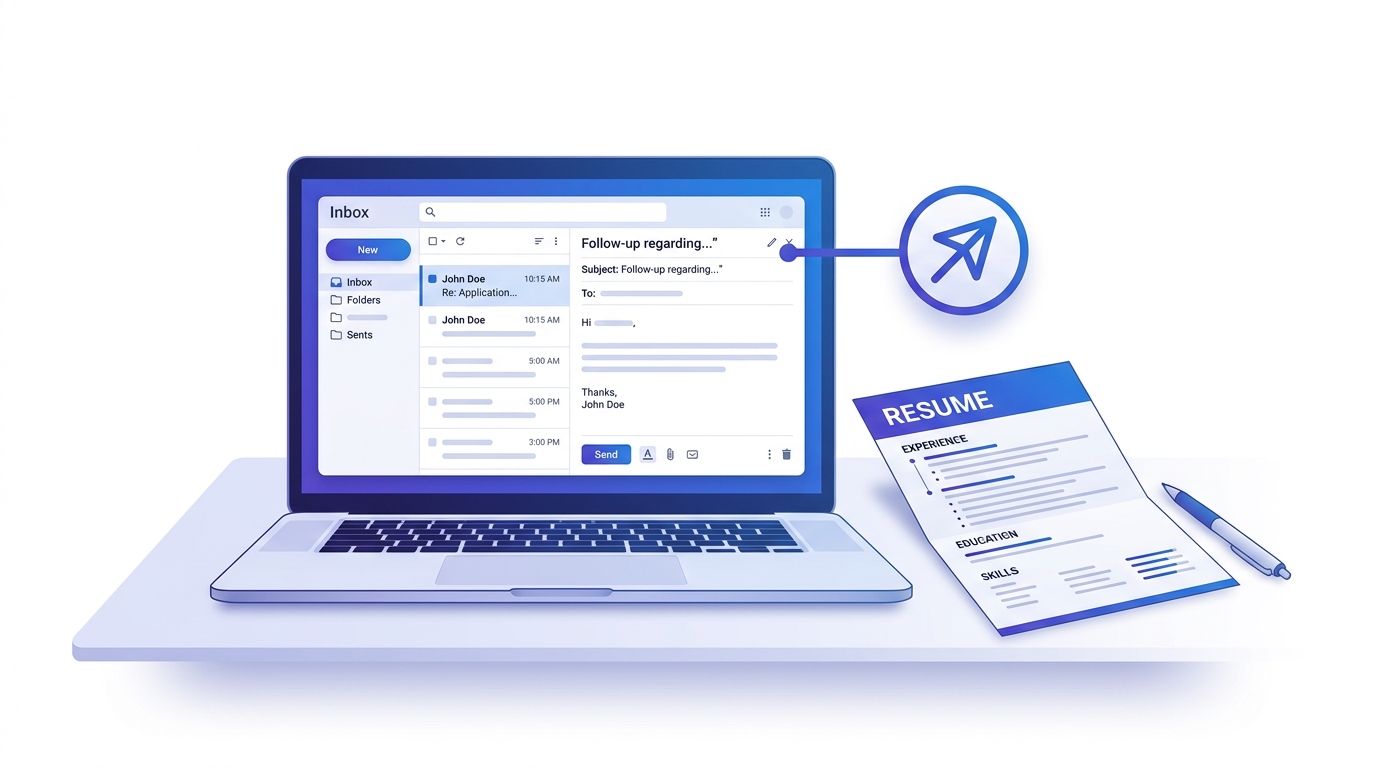
Why a follow-up email matters more than most candidates realise
When a recruiter posts a job opening, the volume of applications they receive in the first seventy-two hours is often staggering. Mid-size companies routinely receive two hundred to five hundred applications per role within the first week. Large organisations and well-known employers frequently receive multiples of that. The practical consequence is that even a genuinely strong application can be overlooked, misrouted, or flagged for later review and never returned to — not because you were unqualified, but because the volume made careful attention to every application impossible.
A follow-up email, sent at the right time and written correctly, does something your initial application cannot do on its own: it surfaces your name a second time, in a different channel, at a moment when a recruiter is actively checking their inbox rather than processing a batch of applications. This second impression, handled well, tells the hiring team three things simultaneously — that you are genuinely interested in this specific role, that you are proactive rather than passive, and that you have the professional communication skills to follow up without overstepping.
Research on hiring behaviour consistently shows that candidates who follow up appropriately are perceived as more motivated and more serious than those who do not. This is not because a follow-up email changes the content of your application — it does not. It is because the act of following up demonstrates a quality that hiring managers are actively trying to assess throughout the selection process: initiative. A candidate who takes professional initiative in the application process is giving the hiring team real evidence of a quality they would otherwise have to infer from the resume alone.
The critical qualifier in everything above is "handled well." A follow-up email that arrives too soon, sounds demanding, or uses language that positions the employer as obligated to respond will produce the opposite effect. Knowing both why to follow up and how to do it correctly is what separates the approach that helps your candidacy from the one that quietly removes it from consideration.
How long to wait before sending your follow-up email
The timing of your follow-up email is just as important as its content. Send it too early and you appear impatient or unfamiliar with professional norms — some hiring managers will interpret a follow-up sent within twenty-four hours of applying as presumptuous. Send it too late and the role may already be filled, or your application may have been reviewed and set aside without a way for you to reopen the conversation.
For most standard job applications submitted through a job board or company career portal, the appropriate window for a follow-up email is five to seven business days after submission. This gives the recruiting team enough time to process the initial application batch, begin screening, and start forming a shortlist — while also landing your follow-up at a moment when your name is still recent enough to be associated with the live role.
If the job posting specified a response timeline — for example, "we will contact shortlisted candidates within two weeks" — honour that window before following up. Following up before the employer's stated timeline communicates that you did not read the posting carefully, which is precisely the opposite of the impression you want to create. In this case, wait until the stated window has passed, then send your follow-up one business day after that deadline.
If you applied directly to a hiring manager rather than through an applicant tracking system, the follow-up window can be slightly shorter — three to five business days is appropriate — because the communication is more direct and the application did not enter a high-volume processing queue. Similarly, if you applied after a referral from someone inside the company, a follow-up at the three-to-four-day mark is reasonable, since the internal referral has already primed the hiring contact to expect your name.
What your follow-up email must contain to be effective
An effective follow-up email has four components, and understanding what each component must accomplish — rather than filling the space with pleasantries — is what separates a message that advances your candidacy from one that is politely noted and then archived.
The first component is a clear, specific subject line. Vague subject lines like "Follow up" or "Checking in" immediately reduce the chance that your email gets opened during a busy inbox day. A subject line that includes the specific role and a clear indication of purpose performs significantly better. For example: "Following Up — [Job Title] Application — [Your Name]" gives the recruiter immediate context without requiring them to open the email to understand what it is about. That specificity also makes it easy for a recruiter to forward it to the right person if they are not the primary contact for the role.
The second component is a brief, direct opening that states your purpose and connects to your original application. Something like: "I submitted my application for the [Job Title] position on [date] and wanted to follow up to confirm it was received and express my continued interest in the role." This sentence does three things cleanly: it places the conversation in context, it is non-demanding in tone, and it reaffirms your interest without sounding desperate.
The third component is a one- or two-sentence value reminder — not a recap of your resume, but a brief, specific reference to why you are particularly well-suited to this role. "My background in [specific relevant skill or experience] and my work on [brief specific example] make me genuinely excited about the possibility of contributing to [company name]'s [relevant team or goal]." This gives the recruiter a substantive reason to return to your original application rather than treating the follow-up as a generic nudge.
The fourth component is a clear, low-pressure close. "I would be glad to provide any additional information you might need and am happy to work around your schedule if a conversation is useful." This close signals availability without demanding a response by a specific time, which is the tone that experienced recruiters respond to positively. Closing with "Please let me know your decision as soon as possible" or "I hope to hear from you soon" may feel natural but reads as pressure — and pressure in a follow-up email is almost never productive.
Tone, length, and language: the details that determine the response
The tone of your follow-up email is doing more communicative work than its content. A technically correct email — right subject line, relevant value reminder, appropriate close — that is written in a tone that reads as anxious, entitled, or obsequious will still fail to produce the outcome you want. Getting the tone right requires attention to a few specific language patterns.
Avoid phrases that place the burden of response on the employer or imply they have made an error by not contacting you. Phrases like "I wanted to make sure my application was not overlooked" or "I noticed I have not heard back" carry a subtle accusatory undertone that most recruiters will pick up on, even if they cannot articulate exactly why the email felt off. Instead, frame everything from a position of professional interest rather than expectation: "I wanted to reiterate my genuine interest in the role" is neutral and confident; "I was wondering why I have not received a response" is not.
Keep the email between one hundred and one hundred and fifty words. This is shorter than most candidates think is appropriate, and it is precisely that brevity that makes the email work. A recruiter who receives a two-hundred-and-fifty-word follow-up email will read it as compensation for anxiety — an attempt to justify the follow-up through sheer volume of words. A recruiter who receives a hundred-word follow-up reads it as the communication of a person who respects their time and knows how to prioritise information. Brevity in a follow-up email is a demonstration of professional calibration, not a lack of effort.
Proofread the email to the same standard you applied to your resume. A typo in a follow-up email has an outsized negative impact because the email is short enough that there is no surrounding content to dilute the error. One typo in a hundred words is much more noticeable than one typo in a thousand-word cover letter. Read it twice before sending, and if possible, read it aloud — this catches word-repetition and awkward phrasing that silent proofreading tends to miss.
How to handle silence after your follow-up email
Sending a follow-up email and receiving no response within five to seven business days places you in a situation that many candidates handle poorly — either by going silent again or by sending multiple additional follow-ups that escalate in urgency. Neither approach serves you well.
If your first follow-up receives no response within five business days, it is appropriate to send a single second follow-up. This second email should be even shorter than the first — three to four sentences at most. Acknowledge that you are following up on your earlier message, confirm that your interest in the role remains unchanged, and offer to provide any additional materials that might be useful. Then stop. Sending more than two follow-ups for the same role almost never produces a positive outcome and frequently damages the impression your original application created.
When you receive no response after two follow-ups, the professional interpretation is that the role has either been filled, the timeline has extended significantly, or your profile did not make the shortlist. In any of these cases, continuing to follow up does not change the outcome — it only risks creating a lasting negative impression with a hiring team you may encounter again in the future, either for a different role at the same company or at a different company where the same recruiter has since moved.
The more productive response to extended silence is to redirect your energy. Continue applying to other relevant roles, refine your application materials based on any patterns you are noticing in the responses you are receiving, and treat the experience as data rather than rejection. Some of the strongest candidacies are built across multiple application cycles, and the candidates who advance most consistently are those who apply the lessons of each cycle to the next without allowing the silence of any individual application to interrupt their momentum.
Adapting your follow-up approach to different application scenarios
The standard follow-up email framework described above works well for most job board applications to corporate employers. But several common application scenarios require a meaningfully different approach, and failing to adapt your follow-up to the context is a frequent mistake that reduces its effectiveness.
When you applied through a referral from someone inside the company, your follow-up strategy should include a separate communication to your referral contact before you send the email to the hiring team. Let your referral know you have applied, thank them for the introduction, and ask whether they are comfortable passing along any information about the timeline or the hiring contact. This keeps the referral in the loop, reinforces the relationship, and may surface information that makes your direct follow-up to the recruiter more precisely targeted.
When you applied to a startup or small company where the hiring manager is likely also a senior leader, your follow-up email can carry slightly more personality and directness than is appropriate for a large corporate application. Small organisations value candidates who demonstrate a clear fit with their culture and speed of operation — a follow-up that reflects genuine knowledge of the company's recent work, specific product developments, or publicly announced initiatives can reinforce that fit in a way that would feel presumptuous in a large enterprise context.
When you applied for a role that explicitly requests no follow-up contact — a fairly common instruction in high-volume hiring processes — respect that instruction. Sending a follow-up in direct contradiction of a stated preference signals that you do not read instructions carefully, which is itself disqualifying information for most roles. In this scenario, the appropriate approach is to redirect your follow-up energy toward strengthening your application materials for the next submission rather than contacting the employer.
Building a follow-up system that keeps your applications organised
Candidates who apply to multiple roles simultaneously — which is the norm in most job searches — often let follow-up opportunities slip simply because they lose track of what they submitted, when, and to whom. The solution is not more effort but a simple tracking system that makes the follow-up process automatic rather than reliant on memory.
Maintain a simple log of every application you submit, recording at minimum: the company name, the job title, the application date, the platform or method used, and the name and contact of the relevant hiring manager if known. Set a calendar reminder for five business days after each application to prompt your follow-up. When you send the follow-up, log the date. When you send a second follow-up, log that date too. When you receive a response — positive, negative, or a request for more information — log the outcome.
This tracking system serves a purpose beyond the immediate job search. After a month of active applications, reviewing your log will tell you which application types and platforms are generating responses and which are not — information that should directly shape where you invest your application energy next. It will also tell you whether your follow-up emails are improving your response rate, which is a useful feedback signal for refining your approach.
At myperfectresumee, we support candidates through every stage of the application process — not just the resume itself. A well-structured resume built with our templates gives your follow-up email something credible to point back to. When your application materials are strong, your follow-up simply needs to be well-timed and well-written to do its job. When both are working together, you significantly improve the odds that your application advances past the initial screening stage and into the interview process where your qualifications can speak for themselves.
Key takeaways
- Send your follow-up email five to seven business days after submitting your application — earlier risks appearing impatient, later may be too late to influence the shortlisting process.
- A strong follow-up contains four elements: a specific subject line, a brief context-setting opener, a one-sentence value reminder, and a low-pressure close.
- Keep the email between one hundred and one hundred and fifty words — brevity signals professional calibration, not lack of effort.
- Avoid language that places the burden of response on the employer or implies they have made an error by not replying.
- Send a maximum of two follow-up emails per application. If both receive no response, redirect your energy to other opportunities.
- Adapt the tone and timing of your follow-up depending on whether you applied through a job board, directly to a hiring manager, or via an internal referral.
- Maintain a simple tracking log for all active applications so that follow-up deadlines are never missed and response patterns can inform your strategy.
Frequently Asked Questions
Yes, as long as you wait five to seven business days and the job posting did not specifically request no follow-up contact. Following up after a job board application is appropriate and often expected in competitive hiring environments. The key is to find a direct contact — usually the hiring manager or the HR contact listed on the company website — and send your follow-up there rather than through the job board's messaging system, which is frequently not monitored.
Use LinkedIn to identify the recruiter or hiring manager for the relevant department and connect with a brief, personalised note that references your application. If LinkedIn is not productive, a professional enquiry through the company's general contact email — addressed specifically to the hiring team for the role — is a reasonable alternative. Avoid calling the company's main phone line to ask about your application status unless the job posting explicitly invited phone enquiries.
Generally, no. Reattaching your resume to a follow-up email can come across as presumptuous — it implies that the hiring team did not keep or read your original application. A better approach is to reference your original submission clearly in the email body, which gives the recruiter easy context to locate the original documents if they want to review them. Only reattach if the follow-up email prompts a specific request for application materials.
A post-interview follow-up is slightly different from a post-application follow-up. Send a thank-you email within twenty-four hours of the interview, then follow up on the outcome if the timeline the hiring manager gave you has passed without a response. At this stage, your email should reference the interview specifically, express continued enthusiasm for the role, and ask politely whether there is an updated timeline. The same principles of tone and brevity apply — clear, warm, and pressure-free.
Yes, when done correctly. Studies on recruiting behaviour consistently show that candidates who follow up professionally are perceived as more motivated, more serious, and more likely to be engaged employees than those who do not. More practically, a well-timed follow-up resurfaces your application in the recruiter's inbox at a moment when your name can be considered actively rather than passively, which increases the probability that your materials receive a closer look during the shortlisting process.