How to List Certifications and Licenses on a Resume (With Real Examples)
Adding professional certifications and licenses to your resume can tilt a hiring decision in your favor, particularly in competitive technical, clinical, financial, and managerial fields. However, many candidates misplace their credentials, omit crucial verification details, or clutter their timeline with low-impact attendance certificates. This comprehensive guide details the hierarchy of professional credentials, four strategic placement models, precise formatting requirements, rules for in-progress and expired credentials, ATS optimization strategies, and full real-world samples you can adapt immediately.
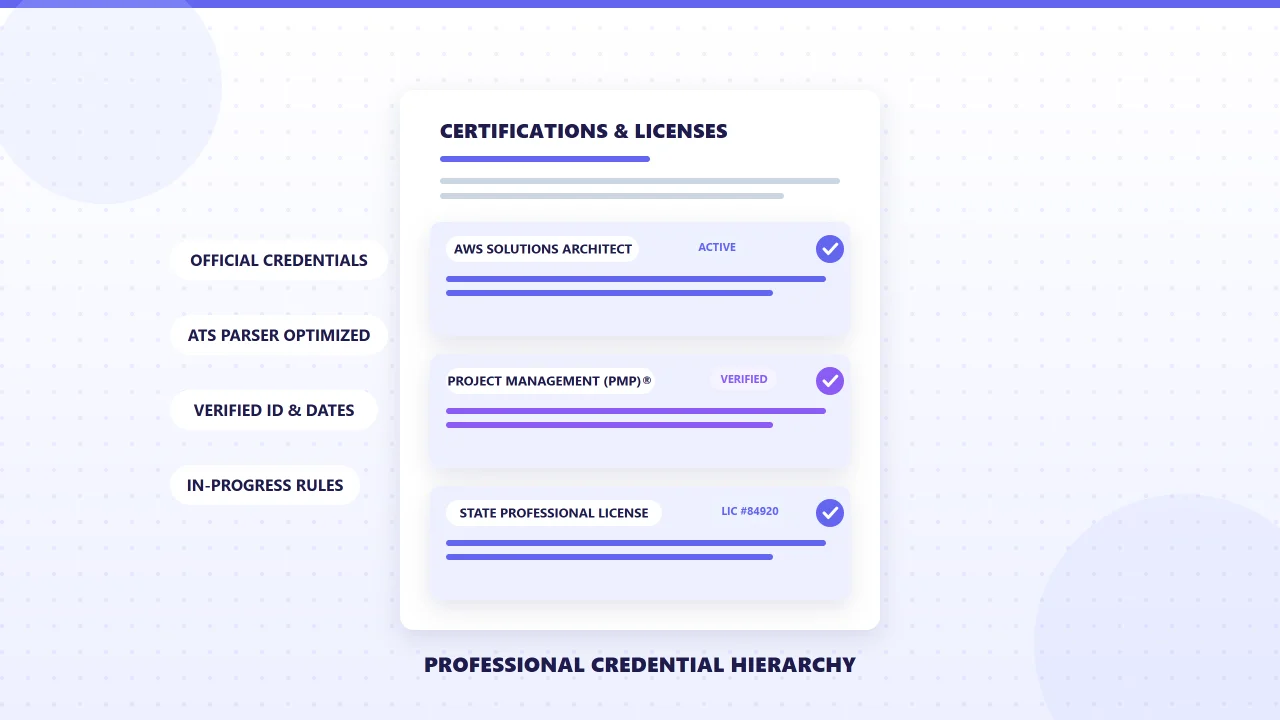
The credential hierarchy: licenses vs. accredited certifications vs. course certificates
Not every certificate carries equal weight in the eyes of a hiring team. When candidates indiscriminately list every webinar badge, corporate internal module, and multi-year government license in one disorganized heap, hiring managers struggle to determine what is legally required, what is professionally respected, and what is merely decorative.
Recruiters evaluate credentials along three distinct tiers of rigor. The top tier consists of statutory and professional licenses granted by government boards or state licensing authorities (such as a Registered Nurse license, Professional Engineer designation, or Certified Public Accountant board registration). These grant legal authority to practice and are non-negotiable prerequisites for regulated positions.
The second tier consists of accredited industry certifications awarded by recognized global bodies after rigorous, proctored examinations (such as AWS Certified Solutions Architect, Project Management Professional (PMP)®, CompTIA Security+, or SHRM-CP). These validate that your capabilities meet established industry standards independently of your current employer.
The third tier consists of certificates of completion from platforms like Coursera, Udemy, or LinkedIn Learning. While these demonstrate personal initiative and curiosity, they usually lack proctored assessments and carry far less weight during corporate candidate evaluations. Over-emphasizing completion certificates on an experienced professional resume often signals insecurity rather than authority.
| Credential Tier | Issuing Body | Recruiter Perception | Resume Placement Strategy |
|---|---|---|---|
| Statutory License | State / National Regulatory Boards | Mandatory condition of employment; high scrutiny | Contact header and prominent top section |
| Accredited Certification | Recognized industry associations (AWS, PMI, Cisco) | Strong proof of domain mastery and high competence | Dedicated certifications section or below summary |
| Certificate of Completion | Online course platforms (Coursera, Udemy, LinkedIn) | Shows self-directed learning; non-evaluative | Grouped under professional development or education |
Understanding this distinction prevents resume dilution. Focus your page real estate on credentials that set you apart or qualify you for the role, while trimming minor attendance badges that distract from your substantive accomplishments.
Where to place certifications on your resume (four proven models)
The ideal location for your credentials depends directly on how vital they are to your target role and your current career stage. There is no one-size-fits-all rule; placing your credentials in the wrong section can hide your greatest asset or push your core work history below the fold.
The first approach is Post-Nominal Header Placement. If you hold an elite, defining credential that immediately defines your profession (such as Jane Doe, CPA or Robert Miller, PMP), append the acronym directly beside your name in the contact header. Follow this up with the complete details in a dedicated certifications section. Reserve this treatment strictly for recognized licenses and advanced certifications; appending minor certificate initials appears amateurish.
The second approach is a Prominent Upper-Section Placement (positioned directly beneath your professional summary). This model is indispensable for IT security specialists, cloud architects, compliance leads, and nursing personnel where an active credential is the primary gating criterion recruiters filter for before reading work experience.
The third approach is a Standard Dedicated Section located beneath your work experience section. This represents the most common format for mid-level and senior professionals in marketing, sales, and general operations whose proven track record of employment accomplishments serves as their main selling point, with certifications serving as valuable supplemental proof.
The fourth approach is Integration into Education. If you hold only one or two foundational credentials or recent short courses, creating an isolated two-line section creates awkward white space. Subsuming them into an "Education & Certifications" section keeps your layout unified and uncluttered.
| Placement Model | Best Suited For | Visual Priority | Typical Headline Example |
|---|---|---|---|
| Header Acronym + Dedicated Section | Regulated professionals (CPA, PE, RN, PMP) | Immediate (Top 10% of page) | Sarah Jenkins, CPA |
| Prominent Section (Below Summary) | Cloud architects, cybersecurity analysts, healthcare | High (Above employment history) | Certifications & Active Licensures |
| Standard Section (Below Experience) | Experienced managers, consultants, software engineers | Medium (Supporting evidence) | Professional Certifications |
| Integrated Education Section | Fresh graduates, entry-level candidates, career switchers | Standard (Bottom third of page) | Education & Professional Development |
When choosing between these layouts, look at the vacancy description. If the posting lists a certification under "Minimum Qualifications", pull that credential to the top half of your document so screening panels verify your eligibility within their initial glance.
The four essential details every certification entry must include
A frequent mistake job applicants make is writing shorthand entries like "AWS Certified" or "Six Sigma". Vague notations force recruiters to guess which specific tier you attained, whether your credential remains active, and whether it can be formally verified during corporate background screening.
To satisfy both technical recruiters and third-party background verification agencies (such as HireRight or Sterling), every professional certification entry should contain four standardized components:
- Full official credential title: Write the complete formal name, followed by its accepted acronym in parentheses (e.g., "AWS Certified Solutions Architect – Associate").
- Issuing organization: Name the official awarding body or licensing board (e.g., "Amazon Web Services", "Project Management Institute", "State Board of Nursing").
- Date of issuance and expiration: List the month and year you earned the credential, followed by the expiration date or "Active through [Year]". If the credential never expires, specify "No Expiration Date".
- Credential ID or verification link: Include the unique license number or a clean verification URL so recruiters can confirm authenticity without requesting paper certificates.
Refining a vague certification entry for corporate scrutiny
PMP Certification, Project Management Institute, 2024
Project Management Professional (PMP)® | Project Management Institute (PMI) | Issued: Apr 2024 · Active through Apr 2027 · Credential ID: 3948201
The revised entry specifies the official registered trademark title, names the accredited issuing institute, provides the three-year validity window, and supplies the verifiable credential ID.
If your credential is tied to a digital badge service (such as Credly or Accredible), hyperlink the credential title directly to your public verification URL. This enables hiring managers reading your PDF on screen to verify your status with a single click while preserving a clean appearance on printed copies.
How to handle in-progress, pending, and expired credentials
Candidates frequently grapple with how to present qualifications that are underway or certifications that have lapsed. Misrepresenting your current standing during an application is one of the fastest paths to immediate disqualification when candidate verification occurs.
If you are actively studying for a rigorous certification and have scheduled your examination, you are entitled to list it—provided you make its pending status crystal clear. Use explicit, transparent phrasing such as "Candidate" or "Expected Completion: [Month Year]". Never use ambiguous phrasing like "Pursuing PMP" without an expected completion date, as recruiters often dismiss vague commitments.
Conversely, if you have merely purchased study materials or watched introductory videos without a confirmed exam booking or formal course enrolment, leave it off your resume. Claiming an unearned qualification damages your integrity if an interviewer tests your knowledge in early screening rounds.
For expired credentials, the general rule is straightforward: if a technical certification has expired because the underlying technology is obsolete (e.g., Microsoft Certified Systems Engineer for Windows Server 2003), drop it completely. If you previously held a prestigious credential but let the maintenance fee lapse (e.g., an inactive PMP), you may list it in an "Archived Credentials" subsection with the historical dates explicitly noted (e.g., "2018 – 2021; Inactive"), signaling past mastery without falsely claiming current standing.
Industry playbooks: best practices for tech, healthcare, finance, and management
Different industries enforce distinct protocols regarding how certifications must be presented. Aligning your formatting with sectoral conventions demonstrates seasoned industry familiarity.
- Information Technology & Cloud Architecture: Group credentials by vendor or functional domain (e.g., Cloud & Infrastructure, Cybersecurity, DevOps). Always include exact exam codes where applicable (e.g., CompTIA Security+ SY0-701 or AWS SAA-C03) so recruiters matching specialized role specs locate them instantly. For broader technical resume alignment, consult our guide to building a powerful resume skills section.
- Healthcare & Nursing: Place your state license number, compact status (e.g., Multi-State eNLC Registered Nurse), and life support certifications (BLS, ACLS, PALS) right below your contact details. Clinical charge nurses and hospital recruiters will not review clinical experience without confirming active state licensure.
- Project Management & Operational Leadership: Emphasize methodology credentials (PMP, PRINCE2, Certified ScrumMaster, Lean Six Sigma Green/Black Belt). Back up these credentials inside your employment history by highlighting the budgets and team sizes governed under those methodologies.
- Accounting, Banking, and Finance: State board license verification numbers (CPA, CFA Charterholder, CMA, Series 7/63/65) should sit beside your name and in an upper section. Clarify state jurisdiction (e.g., "Licensed CPA in California, License #123456").
- Digital Marketing, CRM, and Analytics: Highlight vendor-neutral and major enterprise ecosystem certifications (Salesforce Certified Administrator, HubSpot Inbound Certified, Google Analytics 4 Certification). Ensure dates reflect current tool iterations rather than sunsetted platforms.
If you are pivoting into a new specialization where you lack extensive direct work history, certifications serve as your primary bridge. In those situations, pair your credential with our strategies on crafting a career change resume to demonstrate how theoretical training translates into execution.
Formatting credentials for applicant tracking systems (ATS)
Modern Applicant Tracking Systems scan and parse candidate resumes for specific certification strings defined in the requisition. If the parsing algorithm fails to recognize your credential, your application may never reach human eyes.
The golden rule for ATS compatibility is the Dual-Naming Standard. Hiring managers may search for either the fully spelled-out credential name or its standard acronym. If an ATS recruiter filters candidates using the keyword "Certified Information Systems Security Professional", an application that lists only "CISSP" could be omitted. Always include both versions on the page.
ATS keyword optimization contrast
Certifications: CISA, CISM, AWS-CDA
Certifications: Certified Information Systems Auditor (CISA) | ISACA; Certified Information Security Manager (CISM) | ISACA; AWS Certified Developer – Associate | Amazon Web Services
The revised formatting matches algorithmic queries for both abbreviated acronyms and full statutory titles while documenting issuing authorities.
Additionally, avoid embedding certification logos, badge images, or graphic icons into your resume. While graphical badge graphics look appealing to the human eye, ATS software cannot read image pixels and frequently stumbles over nested tables or complex text boxes containing graphic wraps. Keep your credentials formatted in clean, machine-readable text. For further layout benchmarks, review our complete recruiter-friendly resume guide.
Four complete certification sections you can adapt
The following four practical examples showcase how to structure and present your credentials across diverse career paths. Adapt these frameworks to match your professional achievements.
• AWS Certified Solutions Architect – Professional | Amazon Web Services (Issued: Mar 2024 · Valid through Mar 2027 · Credential ID: AWS-849302)
• Certified Kubernetes Administrator (CKA) | Cloud Native Computing Foundation (Issued: Nov 2023 · Valid through Nov 2026 · Credential ID: CKA-294810)
• HashiCorp Certified: Terraform Associate (003) | HashiCorp (Issued: Aug 2023 · Valid through Aug 2025 · Credential ID: HCTA-740192)
• Red Hat Certified System Administrator (RHCSA) | Red Hat (Issued: Jan 2022 · Valid through Jan 2025 · Credential ID: RH-102938)
• Registered Nurse (RN) – Multi-State Compact License | Texas Board of Nursing (License #948271 · Active & Unencumbered · Expiration: Oct 2027)
• Critical Care Registered Nurse (CCRN) | American Association of Critical-Care Nurses (Issued: May 2023 · Expiration: May 2026 · Cert #849102)
• Advanced Cardiovascular Life Support (ACLS) | American Heart Association (AHA) (Issued: Feb 2024 · Expiration: Feb 2026)
• Basic Life Support for Healthcare Providers (BLS) | American Heart Association (AHA) (Issued: Feb 2024 · Expiration: Feb 2026)
• Project Management Professional (PMP)® | Project Management Institute (PMI) (Credential ID: 3829104 · Active through Dec 2027)
• Certified ScrumMaster (CSM)® | Scrum Alliance (Credential ID: 00129481 · Active through Sep 2026)
• PMI Agile Certified Practitioner (PMI-ACP)® | Project Management Institute (PMI) (Credential ID: 4920192 · Active through Jun 2026)
• Lean Six Sigma Green Belt (ICGB) | International Association for Six Sigma Certification (Issued: Nov 2022 · No Expiration)
• Microsoft Certified: Power BI Data Analyst Associate (PL-300) | Microsoft (Issued: Sep 2024 · Valid through Sep 2025 · Credential ID: MS-948102)
• Google Data Analytics Professional Certificate | Google / Coursera (Completed: Apr 2024 · Credential ID: GDA-583920)
• Tableau Desktop Specialist | Tableau Software (Issued: Dec 2023 · Active · Credential ID: TBS-194820)
• CompTIA Data+ (DA0-001) | CompTIA (In Progress · Scheduled Exam: December 2026)
Six costly certification mistakes that weaken your resume
Even accomplished specialists regularly stumble when presenting qualifications. Protect your credibility by steering clear of these six pervasive traps:
- 1. Cluttering the name header with excessive initials: Adding more than two post-nominal abbreviations (e.g., "John Doe, MBA, PMP, CSM, ITIL, AWS-CP, PSM, Lean GB") looks pretentious and distracts from your identity. Limit the header to your one or two defining statutory credentials and detail the rest in your dedicated section.
- 2. Listing legacy or sunsetted technologies: Highlighting certifications in antiquated systems (such as Windows XP, ancient database servers, or discontinued programming languages) signals outdated expertise rather than senior mastery.
- 3. Padding with trivial, non-proctored attendance badges: Inserting 45-minute webinar attendance tokens or introductory completion certificates diminishes the prestige of your advanced qualifications.
- 4. Leaving out the issuing organization or licensing board: Stating only the certificate title forces recruiters to wonder who accredited the program. Always provide the governing organization.
- 5. Listing credentials without connecting them to workplace impact: Earning a credential proves you understand the theory; hiring managers want to see how you applied it. Always tie your certifications back to real achievements in your work history bullets.
- 6. Fabricating or exaggerating certification status: Claiming a credential you have not earned or reporting an expired license as active is detected immediately during pre-employment background checks and results in revoked offers.
By maintaining honesty, accuracy, and clear organization, your certifications become authoritative proof of your technical acumen, professional discipline, and career momentum. If you are preparing an entire application package from scratch, explore our curated resume templates designed to balance credentials, work history, and technical proficiencies elegantly.
Key takeaways
- Differentiate between mandatory statutory licenses, accredited industry certifications, and non-proctored course completion certificates.
- Position credentials according to career priority: post-nominal header for defining licenses, upper section for technical specialists, and standard section for mid-career professionals.
- Always provide the four essential attributes: full official title, accredited issuing body, issuance and expiration dates, and verifiable credential ID.
- List in-progress credentials only when you are actively enrolled with a confirmed target date, using transparent phrasing like "Expected Completion: [Month Year]".
- Follow the dual-naming standard for ATS optimization by including both the spelled-out certification title and its recognized industry acronym.
- Support your credentials with tangible evidence by demonstrating inside your work experience bullets how that knowledge produced real business outcomes.
Frequently asked questions
If you are a student, recent graduate, or career transitioner lacking direct industry experience, place your certifications section prominently on the upper half of your resume, immediately beneath your professional summary or education section. In the absence of an extensive employment history, verified credentials provide hiring managers with objective proof of your technical capability and self-directed discipline.
Generally, do not list expired certifications, particularly in fast-evolving technical fields where outdated credentials imply that your skills have not kept pace. However, if an expired credential represents significant past mastery on an enterprise legacy system relevant to the vacancy, you may list it in an "Archived Credentials" subsection with historical dates explicitly stated (e.g., "2019 – 2022; Inactive") to ensure transparency.
Yes. Once you have officially passed the qualifying examination and received verification from the testing administrator, you may list the credential on your resume. You can specify "Exam Passed – Official Credential Pending" alongside the date to maintain full transparency while reassuring employers that you possess the requisite qualification.
Focus on quality and relevance rather than volume. A curated list of 3 to 6 accredited, role-specific certifications is substantially more compelling than an exhaustive catalog of 15 minor course badges. Include only credentials that align directly with the core responsibilities outlined in your target job announcement.
They can be included if they demonstrate relevant skill acquisition for entry-level applicants or professionals closing a career gap. However, group them under a dedicated "Continuing Professional Development" or "Relevant Coursework" subheading rather than mixing them with high-stakes, proctored industry certifications like PMP, AWS, or CPA.