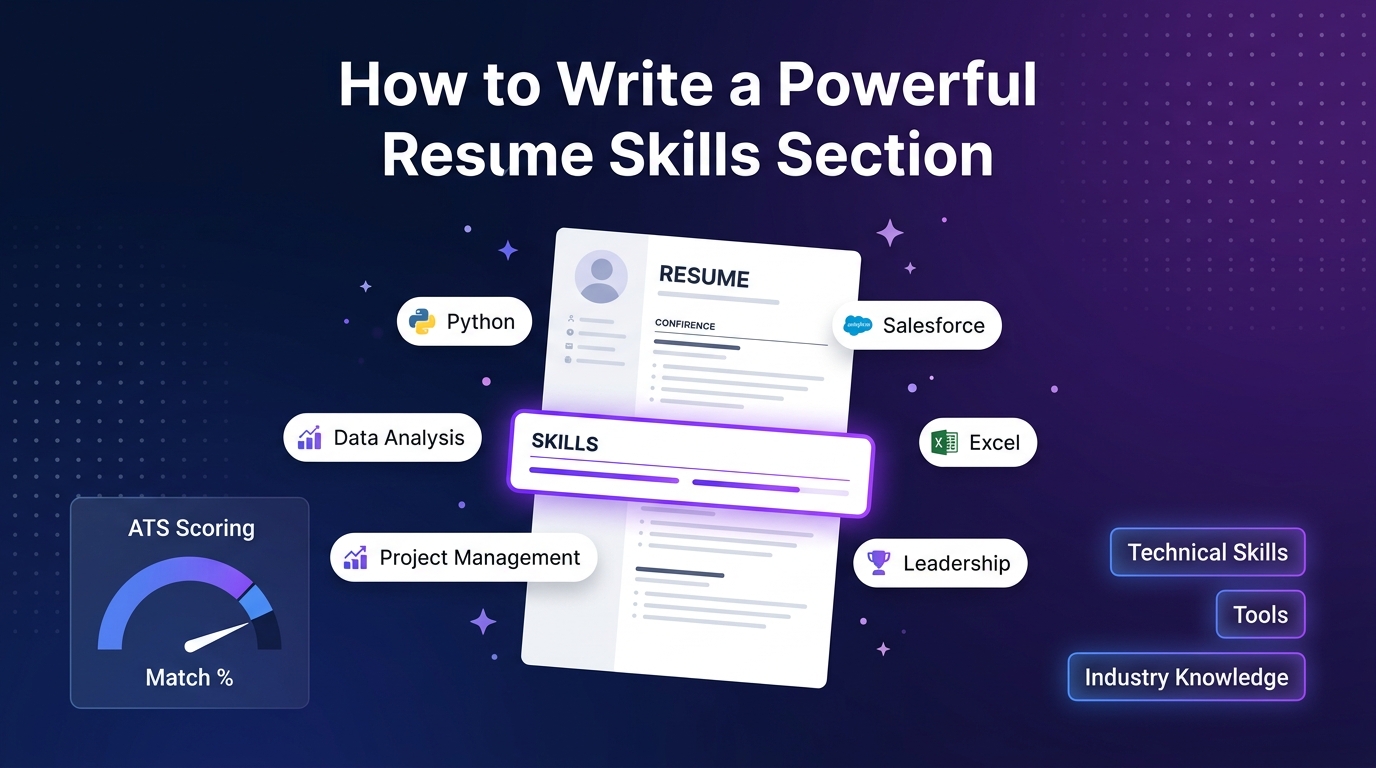
How to Write a Powerful Resume Skills Section
A strong resume skills section does three things at once: it satisfies the keyword requirements of screening systems, it gives a human recruiter an instant sense of your professional range, and it reinforces every claim made in the experience section. This post explains how to decide which skills to include, how to organise them so the most important appear first, and how to avoid the padding and inflation that make many skills sections actively harmful rather than helpful.
Why the skills section matters more than most candidates realise
Most candidates treat the skills section as an afterthought — a quick list appended at the bottom of the page once the experience and education sections are finished. That approach misunderstands what the skills section actually does in the evaluation process. For screening systems, the skills section is often the primary scoring surface. Many recruitment platforms pull hard skills and technical tools directly from that section and compare them against a predefined list derived from the job description. A skills section that is sparse, vague, or misaligned with the job description will produce a low match score regardless of how strong the rest of the document is.
For human reviewers, the skills section serves a different but equally important function. A well-organised list of ten to fourteen skills allows a recruiter to assess professional range within seconds. Recruiters who review dozens of applications in a single session appreciate a skills section that answers a simple question quickly: does this person have the core capabilities this role requires? When the answer is visible without reading the full document, the resume earns a more careful reading of everything else.
The skills section also functions as a promise. Every skill listed there is implicitly available for discussion in an interview. A section that lists skills you genuinely possess and can speak to with specific examples builds credibility throughout the application process. A section that lists skills you added to please screening software but cannot substantiate in conversation creates problems that surface the moment an interviewer asks you to walk through an example. The skills section should be ambitious but honest, aligned but accurate.
Understanding this dual audience — the machine that scores your document and the human who reads it — is the starting point for building a skills section that actually works. Every decision about what to include, how to phrase it, and where to place it should be made with both audiences in mind simultaneously.
The difference between hard skills, soft skills, and technical tools
Before listing anything, it helps to understand the three distinct categories that belong in a skills section and the weight each one carries. Hard skills are learned competencies with a clear definition: data analysis, financial modelling, contract negotiation, project planning. They can be taught, tested, and verified. They are the primary currency of the skills section because they are searchable, specific, and directly tied to the requirements of most roles.
Technical tools are a subset of hard skills but deserve separate consideration because they tend to be scored individually by recruitment platforms. The name of a platform or software package — Salesforce, AutoCAD, Python, Adobe Premiere, HubSpot — is typically treated as a discrete keyword. Including the correct tool name matters more than describing how you use it, at least at the screening stage. Use the exact product name the employer uses, not an abbreviation or a generic description. An screening software looking for "Tableau" will not match "data visualisation software".
Soft skills present a more complicated problem. Terms like communication, leadership, attention to detail, and adaptability carry almost no weight in screening software scoring because they appear on nearly every resume submitted for every role. They are also the hardest claims to verify from a document alone. The honest approach is to demonstrate soft skills through the content of your experience bullets rather than list them as standalone items in the skills section. A resume that includes a bullet describing how you led a fourteen-person cross-functional team communicates leadership far more persuasively than a line in the skills section that simply says "leadership".
This does not mean soft skills are invisible on the final document. It means they belong in the experience section as demonstrated behaviours rather than in the skills section as asserted qualities. Once you apply that filter, the skills section becomes cleaner, more credible, and more useful for both screening software and the recruiter who reads it.
How to decide which skills to include
The most reliable method for building a relevant skills list begins with the job description. Read the posting carefully and identify every skill, tool, methodology, and qualification it mentions explicitly. Separate them into two groups: requirements and preferences. Requirements are the baseline — if you genuinely have them, they belong in your skills section. Preferences are where you can differentiate your application by demonstrating that you exceed the minimum threshold.
Cross-reference that job description list against your actual experience. Only include skills you have used in a professional, academic, or project context that you could discuss with specific examples in an interview. The filter is simple: if someone asked you in an interview to describe a situation where you applied this skill, could you give a real, detailed answer? If yes, include it. If no, leave it out. The cost of including a skill you cannot substantiate is higher than the cost of leaving a gap.
Beyond the job description, consider skills that appear across multiple job descriptions in your target field, not just the one you are currently applying for. These recurring skills represent the core competency expectations of the sector. Including them — provided they are honest — makes your resume useful across a range of applications, not just this one. That relevance is particularly valuable when you are in an active job search and applying to several similar roles simultaneously.
Finally, revisit your experience section and identify skills that are implied by your bullets but not stated explicitly anywhere. If you wrote a bullet about building a financial model in Excel, "Advanced Excel" and "financial modelling" are both legitimate skills entries. The experience section and the skills section should reinforce each other — a skill listed above should appear, in practice, somewhere in the experience below. That alignment is what makes the document feel coherent rather than constructed.
How to organise the skills section for maximum impact
The order in which skills appear within the section communicates priority. The first skill a recruiter reads is the one they will associate most strongly with your profile. That position belongs to the skill most central to the role you are applying for — not the skill you happen to feel most confident about, and not the skill that appears first alphabetically. Read the job description again, identify the single most important technical requirement, and list it first.
After the leading skill, group related capabilities together rather than listing everything in a single undifferentiated line. A skills section divided into short, labelled groups — for example, Technical Skills, Industry Knowledge, and Tools — makes it easier for a recruiter to find what they are looking for quickly. It also makes the document look more organised and deliberate, which signals a level of professional self-awareness that an undifferentiated list does not.
Keep the total number of skills between eight and fourteen for most roles. Fewer than eight can look thin, particularly if the role is technically demanding. More than fourteen starts to look like a keyword dump — a tactic that experienced recruiters recognise and distrust. The goal is a list that looks curated rather than comprehensive. Every skill on the list should feel like a deliberate choice rather than the result of adding everything that seemed plausible.
For roles where proficiency level matters — programming languages, foreign languages, software platforms — consider adding a brief proficiency descriptor after the skill name: "Python (intermediate)", "Spanish (conversational)", "Illustrator (advanced)". This is optional, but it prevents the resume from creating expectations it cannot meet. A recruiter who assumes expert-level proficiency based on a skills list and then discovers in an interview that the skill is more limited will feel misled. A honest descriptor is a small investment in the credibility of the whole application.
Tailoring the skills section for each application without rebuilding it from scratch
A well-structured skills section requires only minor adjustments between applications, not a complete rebuild. The core of the section — the skills you genuinely have and use regularly — remains stable. What changes is the ordering and the selection of items at the margin. For each new application, read the job description, identify the two or three skills it emphasises most strongly, and confirm they appear at or near the top of your skills list. Then check whether any skills mentioned in the description are present in your inventory but currently absent from the section, and add them if they are honest entries.
This approach takes five to ten minutes rather than the twenty to thirty that a full rebuild would require. It is also more sustainable when you are in active search mode and applying to multiple roles. Maintaining a master list of all the skills you genuinely possess — a longer document that is never submitted directly — gives you a reference point for every tailored version. Pull from that master list based on relevance, and the tailored section becomes a deliberate curation rather than a guessing exercise.
The most common tailoring mistake in the skills section is removing skills that are genuinely relevant in order to add space for skills the job description mentions but the candidate does not actually have. That is the wrong trade-off. Remove skills that are irrelevant to this specific role — skills from a different industry or an outdated tool that the posting does not mention. Do not remove genuine strengths to make room for performance. A shorter list of honest skills will always outperform a longer list that includes inflated claims.
On myperfectresumee, the template editor makes it easy to reorder and update the skills section between applications without redesigning the whole document. The structure holds while the content shifts, which is exactly the kind of flexibility an active job search requires. Use the saved version history to track what you submitted to each employer, so you can return to the correct version if a callback comes weeks after the application.
Skills sections that hurt more than they help
A skills section full of generic soft skills — motivated, team player, self-starter, detail-oriented — tells a recruiter nothing useful. These terms appear on almost every resume in every field, which means they carry no differentiating weight. Worse, they fill space that could be used for specific, searchable hard skills that actually matter to the role. If your skills section contains more soft skill labels than technical competencies, it needs to be restructured before the document goes out.
Outdated technology is another common problem. Listing a software platform that has been deprecated or superseded signals that your professional development stopped at some point in the past. Similarly, listing a certification that expired several years ago draws attention to a gap rather than a qualification. Skills and tools should reflect your current, active professional repertoire. If a tool you list has not been part of your working practice for more than two or three years, consider whether it still belongs on the document.
Inflated proficiency claims create interview risk. Listing a skill as expert-level when your genuine proficiency is intermediate sets up a credibility problem the moment the interviewer explores it. The skills section is read carefully by people who know the field. An interviewer who asks a follow-up question and receives an uncertain answer from someone who listed themselves as an expert will adjust their evaluation of the entire application, not just that one skill. Honest proficiency levels protect the rest of the document.
Finally, avoid listing skills so broad they become meaningless. "Microsoft Office" has been on resumes since the mid-1990s and tells a recruiter almost nothing in 2026. If Microsoft tools are genuinely relevant to the role, be specific: "Advanced Excel (pivot tables, VLOOKUP, Power Query)", "PowerPoint (executive-level presentations)", "Word (template design, mail merge)". The specific version of the skill is the evidence that the general version is not.
Matching your skills section to where you are in your career
The right content for a skills section changes significantly depending on career stage. An entry-level candidate with limited professional experience should lead with technical and academic skills that demonstrate readiness for the role: the programming languages learned during study, the research methods applied in a dissertation, the tools used during an internship. For a fresher, the skills section often carries more evidential weight than the experience section, simply because the experience section is short. That means the skills list needs to work harder and be constructed more carefully.
A mid-career professional should prioritise industry-specific technical skills and recognised methodologies over general tools. At this stage, the recruiter is evaluating depth as well as breadth. A skills section that shows mastery of two or three central competencies alongside supporting capabilities is more impressive than a long list that suggests surface familiarity with many things and deep expertise in none.
Senior candidates and executives often find that a traditional skills section becomes less useful as their career progresses. At the senior level, the evidence in the experience section carries the credibility. A brief skills section focused on strategic capabilities — organisational transformation, enterprise technology adoption, multi-geography team management — can still be valuable, but it should function as a high-level orientation to the document rather than a detailed technical inventory. The emphasis shifts from what tools you can use to what problems you have solved at scale.
In every case, the guiding principle remains consistent: the skills section should be a credible, curated, and current representation of what you genuinely bring to the role. It is not a declaration of aspiration or a list of everything you have ever encountered. It is a statement of professional readiness, visible in ten seconds, and defensible in a thirty-minute interview. That combination — quick to read, honest to support — is what makes a skills section genuinely powerful rather than decorative.
Key takeaways
- Hard skills and technical tool names are the primary currency of the skills section — soft skills belong in the experience section as demonstrated behaviours.
- Use the job description as the starting point: only include skills you genuinely have and could discuss with specific examples in an interview.
- List the most important skill for this role first; order communicates priority to both screening software and the human recruiter.
- Keep the total between eight and fourteen items — a curated list signals deliberate self-awareness; a long list signals keyword padding.
- Add proficiency levels for skills where the gap between beginner and expert matters significantly to the role.
- Maintain a master skills list and tailor from it for each application rather than rebuilding the section from scratch.
Frequently Asked Questions
For most mid-career and senior candidates, the skills section works best after the professional summary and before or alongside the experience section. For freshers and early-career candidates who have limited work experience, placing the skills section higher — directly after the summary — can be more effective because it establishes professional readiness before the recruiter reaches an experience section that is necessarily brief. The placement should serve the strongest evidence first, and that priority differs depending on where you are in your career.
Between eight and fourteen skills is the range that works best for most roles. Fewer than eight can look underprepared, particularly for technical roles. More than fourteen starts to look like keyword stuffing, which experienced recruiters identify quickly and treat with scepticism. The exact number is less important than the quality and relevance of every item on the list. If you cannot justify why each skill belongs there in terms of the specific role, it probably should not be included.
Yes, with transparency. A skill gained through structured learning — a university course, a professional certification, a dedicated online programme — is a legitimate entry, particularly for early-career candidates. The honest way to present it is either to add a context note such as "(certified, 2025)" or to ensure that the bullet in your experience or education section references how you applied the skill, even in a project or academic setting. A skill listed without any supporting context in the rest of the document may raise questions in an interview that you should be prepared to answer.
The two terms are sometimes used interchangeably, but in practice a competencies section tends to include higher-level, strategic capabilities — analytical thinking, cross-functional leadership, stakeholder management — while a skills section focuses on specific, measurable, and often technical capabilities. Senior candidates and executives sometimes use a competencies section instead of a traditional skills list because it better reflects the level at which they operate. For most candidates, a skills section with specific entries is more useful because it is more easily scored by screening tools and more quickly interpreted by a human reader scanning for role-specific qualifications.
For basic office tools that every candidate in the applicant pool will have, listing them adds nothing unless you can add specificity. "Microsoft Word" alone is not a differentiating skill for most office roles. However, "Microsoft Word (template design, track changes, advanced formatting)" signals a level of proficiency that goes beyond baseline and is worth including. The rule of thumb is that obvious skills become worth listing when you can add a meaningful qualifier that signals depth rather than minimum competency.