How to List Freelance Work on a Resume (With Real Examples)
Presenting freelance work on a resume poses a dilemma. Listing every short project individually fragments your timeline, while omitting independent work creates an artificial employment gap. The practical solution is selecting an appropriate structure: grouping projects under a unified umbrella entry, choosing professional job titles, describing confidential assignments safely under non-disclosure agreements, and highlighting verified business results. This guide covers three proven formats, provides concrete bullet rewrites, and supplies adaptable samples for independent professionals.
The three ways to format freelance work (and when to use each)
Treating freelance work as an afterthought confuses reviewers. Hiring managers need an immediate grasp of your trajectory. Choose one of three formats for your situation.
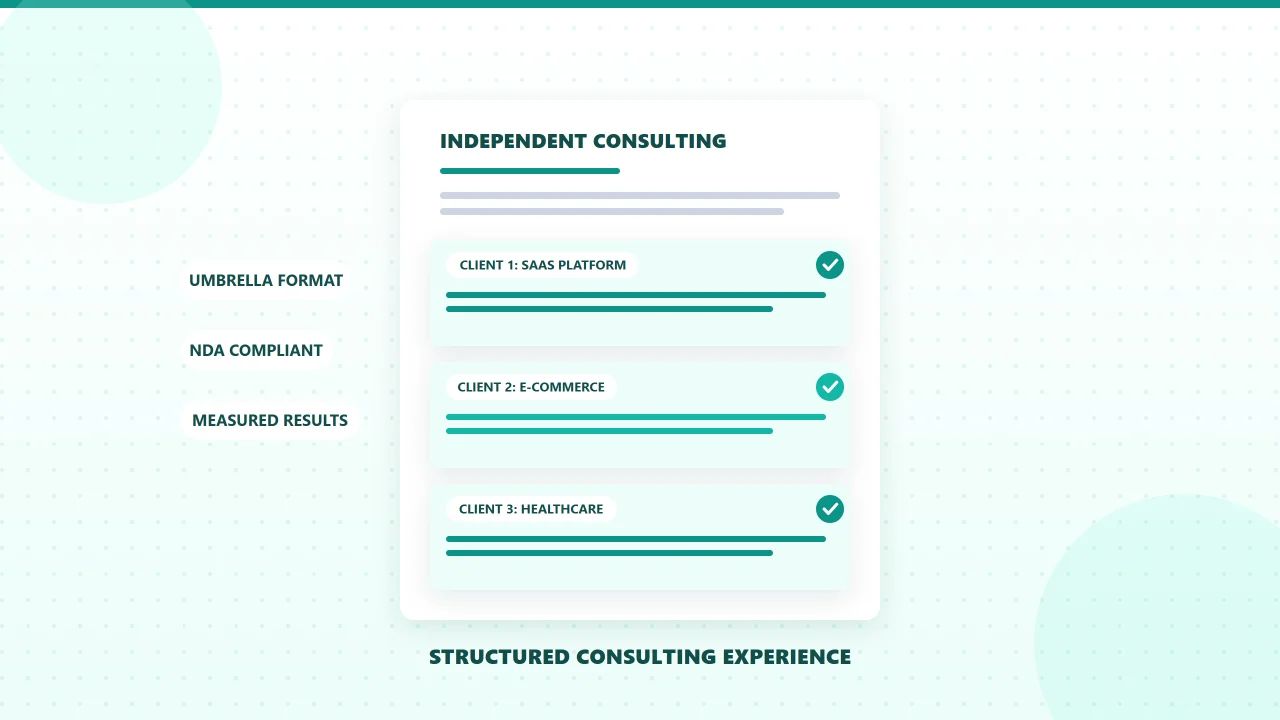
For full-time independent professionals, the Umbrella Model works best. Rather than listing separate entries for short gigs, create a single heading like "Independent Consulting". Beneath it, summarize your focus and showcase two to four major client deliverables as sub-entries. This preserves an unbroken timeline.
The second method is the Individual Contract Model, suited for consultants who completed substantial engagements (nine months or longer) with recognized organizations. Each client role appears as its own entry, explicitly tagged as contract employment.
The third approach is a dedicated Consulting & Projects section beneath your primary work history. This fits professionals who took on paid assignments alongside a regular job, highlighting technical versatility without blurring primary employment.
| Format | Best suited for | Key advantage | What to watch out for |
|---|---|---|---|
| Umbrella entry | Full-time freelancers with multiple clients | Continuous, clean career timeline | Curate carefully to avoid clutter |
| Individual contracts | Long contracts (9+ months) for known brands | Leverages corporate brand recognition | Can suggest job-hopping if brief |
| Dedicated section | Side consulting alongside a salaried role | Keeps core employment distinct | Limit to 2 or 3 projects |
Whichever structure you choose, maintain consistent dates and margins so the section blends naturally with your career history.
Job titles that recruiters take seriously
Your job title establishes how independent work is evaluated. Generic labels like "Freelancer" tell readers nothing about your functional discipline and sound informal.
Conversely, assigning yourself executive titles when working as a solo contributor hurts credibility. Designating yourself "CEO and Founder" when applying for a mid-level engineering or analyst role feels misaligned and complicates background checks.
The ideal title combines your functional discipline with a professional qualifier: "Independent Consultant", "Contract Software Engineer", "Freelance UX Designer", or "Principal Copywriter". This communicates your domain while maintaining transparency.
Refining an independent job title
Self-Employed | Digital Marketing Specialist (2024 - Present)
Independent Consultant | Digital Marketing & Growth Strategy (2024 - Present)
The revised title names the functional discipline clearly, avoids ambiguous labels, and matches corporate job requirements.
If you have deep vertical expertise, append your industry focus directly to the title, such as "FinTech & Payments". For related advice on framing credentials, see writing a resume summary that gets noticed.
How to handle non-disclosure agreements and confidential clients
Freelancers frequently sign confidentiality agreements. While you may have built critical software, contractual terms often prevent naming the client publicly.
You never need to break an agreement to prove expertise. Hiring managers encounter confidential projects routinely and value discretion. The standard approach is descriptive substitution: replace client names with an industry descriptor and operating scale.
Instead of naming a private company, cite "Series B HealthTech Platform", "Tier-1 Auto Component Maker", or "Regional Commercial Bank". Then focus your bullet points on the challenge, technologies utilized, and quantifiable impact achieved.
Describing client work under an NDA
Developed backend services for client under strict NDA (details confidential).
Architected predictive churn pipeline for a Series B SaaS provider using Python and PostgreSQL, identifying risk indicators across 40,000 accounts and reducing churn by 14%.
The revision safeguards confidentiality while providing hiring managers with concrete data volumes, technical tooling, and commercial impact.
Writing measurable bullets that prove business value
Candidates often list generic tasks rather than business outcomes. Bullets like "Handled design requests" or "Wrote technical articles" explain duties but fail to prove competence.
Unlike salaried positions where duties are routinely assigned, freelance engagements require direct commercial accountability. Your bullet points should reflect that ownership by following a concise structure: Action Verb + Scope of Project + Measurable Business Outcome.
Transforming freelance tasks into business outcomes
Designed marketing assets and promotional banners for small business clients.
Designed campaign visual assets and landing pages for 3 retail brands, lifting average checkout conversion by 18% across 60,000 seasonal visitors.
The updated bullet highlights client volume, specific deliverables, audience traffic, and verifiable conversion growth.
Two complete resume formats you can adapt
The examples below illustrate how to structure independent experience across common career situations. Adapt these frameworks to match your professional background.
Principal Full-Stack Developer & Cloud Architect | Jan 2024 – Present
Operate an independent consulting practice delivering cloud migrations, API architecture, and web systems for growth-stage technology clients.
Selected Client Engagements:
• Logistics Platform (Series A): Architected automated dispatch microservices using Go and AWS ECS, cutting routing computation latency by 35% across 1,200 daily freight dispatches.
• Regional Healthcare Network: Migrated clinical database to managed PostgreSQL with zero downtime, protecting 250,000 records and accelerating report queries by 40%.
• FinTech Services Provider: Refactored merchant verification workflows, reducing customer onboarding turnaround from 48 hours to 15 minutes.
APEX TECHNOLOGIES | Bengaluru, Karnataka
Senior Product Marketing Manager | Mar 2023 – Present
• Direct go-to-market execution for core SaaS products driving ₹3.8 Crore in annual subscription revenue.
• Supervise a marketing team of 4, increasing qualified inbound leads by 26% year-over-year.
FREELANCE & CONSULTING PROJECTS
Independent Marketing Strategist | Jun 2024 – Present
• EdTech Mobile Application: Developed brand positioning, message hierarchy, and go-to-market plan for mobile learning app, helping client onboard 12,000 beta users in 60 days.
• B2B Analytics Firm: Conducted content audit across 80 technical case studies, improving search impressions by 38% over four months.
Transitioning from freelancing to a salaried role: addressing recruiter concerns
When hiring managers evaluate candidates returning to corporate employment after freelancing, they often hold three unstated concerns:
- Adaptability to organizational hierarchy: Having acted as your own manager, will you take direction and work effectively within established corporate guidelines?
- Work continuity and intent: Was freelancing a proactive, deliberate choice or an unintended gap between corporate positions?
- Long-term commitment: Will you remain engaged for years, or will you depart when outside consulting opportunities appear?
Counter these concerns proactively. In your resume summary, state that you are specifically targeting a permanent, full-time position where you can direct your energies toward long-term organizational objectives.
In your bullet points, draw attention to collaborative experiences: working alongside internal engineering leads, coordinating with client departments, or delivering against structured sprint schedules. This shows you are accustomed to team environments and corporate rhythms.
In interviews, frame the move positively: "Freelancing sharpened my commercial awareness and client communication. However, I missed long-term ownership of a single product alongside a permanent team. That shared focus is why I am prioritizing this full-time role."
Five costly mistakes to avoid on a freelance resume
Independent contractors often make simple errors that detract from strong experience. Keep your resume sharp by avoiding these five practices:
- 1. Leaving freelance work off entirely. Omitting consulting between roles creates an artificial employment gap. Listing real projects proves continuous professional momentum.
- 2. Listing marketplaces as your direct employer. Writing "Upwork" or "Fiverr" as your company heading is incorrect. Those platforms are payment intermediaries, not employers. Name your practice or use "Independent Consultant".
- 3. Splitting your timeline into brief gigs. Displaying multiple micro-projects as separate jobs clutters the page. Group them into an umbrella entry highlighting your strongest engagements.
- 4. Misrepresenting contract roles as direct staff positions. Never list yourself as a permanent employee if retained as an external contractor. Background checks verify payroll records, and discrepancies can disqualify you.
- 5. Neglecting client references. Client executives and department heads often serve as exceptional references. Their endorsements carry substantial weight with corporate hiring teams.
Key takeaways
- An umbrella entry keeps multiple freelance engagements organized within an unbroken, easy-to-read career timeline.
- Select grounded job titles like "Independent Consultant" or "Contract Engineer" instead of informal or exaggerated designations.
- Comply with non-disclosure agreements by substituting specific client names with clear industry categories and operational scales.
- Frame bullets around commercial impact: the client problem, the actions taken, and the quantified business result.
- When freelancing alongside a corporate job, maintain a distinct "Consulting & Selected Projects" section to protect your primary timeline.
- Dispel recruiter concerns regarding full-time commitment by highlighting cross-functional teamwork and a desire for sustained product ownership.
Put this into practice
- Want to turn your achievements into hard numbers? Read how to quantify achievements on your resume for formulas and examples.
- Switching industries or moving from self-employment to an enterprise role? Check how to write a career change resume.
- If you took time off between client contracts, see our practical guide to explaining career gaps on your resume.
Frequently asked questions
Yes, provided assignments align with your target job. Part-time consulting shows strong initiative and current technical competence. Group these under a separate "Selected Projects" section so reviewers recognize the work was concurrent with primary employment.
A registered company is not necessary to list freelance consulting. Write "Independent Consultant" or "Contract Specialist" in the employer line, followed by "Remote" or your city. Reviewers focus on project substance and impact rather than registration paperwork.
Verification services validate contract work through documents such as client service agreements, invoices, tax records, bank statements showing payments, or direct reference verifications from client managers. Maintain orderly records to facilitate checks.
This situation is routine in enterprise software, finance, and healthcare. Focus descriptions on technical architecture, problem scopes, and verified percentage improvements without naming confidential entities. In interviews, offer sanitized workflow walkthroughs.